
R Tutorial
Learn R
R is a programming language.
R is often used for statistical computing and graphical presentation to analyze and visualize data.
Start learning R now »Examples in Each Chapter
With our "Try it Yourself" editor, you can edit R code and view the result.
Example
How to output some text, and how to do a simple calculation in R:
"Hello World!"
5 + 5
Result:
                    [1] "Hello World!"
[1] 10
Example
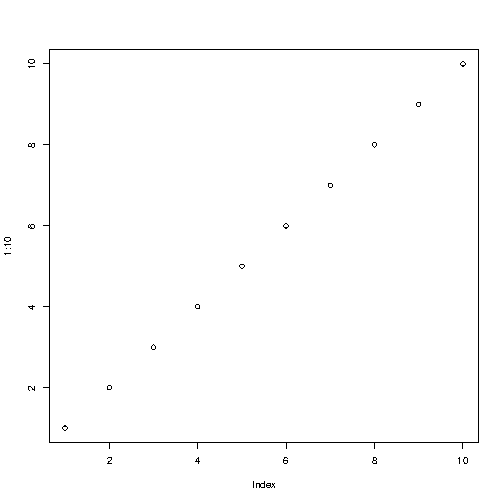
How you can use R to easily create a graph with numbers from 1 to 10 on both the x and y axis:
plot(1:10)
Result:
We recommend reading this tutorial, in the sequence listed in the left menu.
R Exercises
R Quiz
Learn by taking a quiz! This quiz will give you a signal of how much you know about R.
R Examples
Learn by examples! This tutorial supplements all explanations with clarifying examples.
About R
What is R?
R is a programming language and environment for statistical computing, data analysis, and visualization. It is especially popular among statisticians, analysts, researchers, and data scientists.
- Supports many statistical methods: regressions, clustering, time series, etc.
- Has a huge number of packages (over 22,000) that extend its functionality.
- Open and free: distributed under the GNU GPL license.
History of R and its authors
- The R programming language was created by Robert Gentleman and Ross Ihaka in 1991 at the University of Auckland in the Department of Statistics, New Zealand.
- The name "R" is a play on words: successor to the S language and the first letters of the authors' names.
- The language was publicly released in 1993, and since 2000 it has been a full-fledged GNU project.
What kind of language is this?
R is an interpreted, object-oriented language with powerful capabilities for data manipulation, computation, and graphical display. It is based on the S language developed at Bell Labs. R is part of the GNU Project and is released under the GNU General Public License.
Key features of R:
- Statistical functionality: R provides a huge number of built-in functions for statistical analysis, including linear and nonlinear models, classical statistical tests, time series analysis, classification, clustering, and much more.
- Graphics: R has exceptional capabilities for creating high-quality graphics and data visualization. It allows you to create various types of charts (scatter, column, box, histogram, etc.) with a high degree of customization.
- Extensibility: One of the greatest strengths of R is its extensibility. There are a huge number of packages (libraries) that extend the functionality of R by adding new algorithms, models, and tools for solving specific problems. These packages are available through the CRAN (Comprehensive R Archive Network) repository.
- Community: R has a very active and large community of users and developers who create new packages, provide support, and share knowledge.
- Open source: As open source software, R is free to use, modify, and distribute.
Where is R used?
R is actively used in many industries:
- 📈 Finance: Risk modeling, market analysis, portfolio optimization.
- 🧬 Bioinformatics: Analysis of genetic data, disease research.
- 🏥 Medicine: Clinical research, epidemiology, personalized medicine.
- 🛍️ Marketing: Customer behavior analysis, segmentation, sales forecasting.
- 🌱 Ecology: Climate modeling, environmental impact assessment.
- 🧪 Academic research: Statistical calculations, visualization of results, machine learning.
Development prospects
The prospects for R development are very promising:
- Growing popularity: R continues to gain popularity in the world of data analysis and data science, competing with languages such as Python.
- Active community: A large and active community is constantly creating new packages and improving existing ones, which ensures rapid development and adaptation of R to new challenges.
- Integration with other technologies: R is increasingly integrated with other tools and technologies such as Python, Spark, Hadoop, SQL databases, which expands its application in complex Big Data environments.
- Performance optimization: Work is constantly being done to optimize the performance of R, in particular for working with large amounts of data.
- Development of interactive web applications: With the advent of packages such as Shiny, R is becoming increasingly popular for creating interactive web applications for data visualization and analysis, which makes analytics accessible to a wide range of users.
- Deepening machine learning capabilities: New packages are being developed and existing ones are being improved to implement advanced machine learning and deep learning algorithms in R.
Official website and downloads
Official website of the R programming language: https://www.r-project.org/.
You can download R from the official website at the link: https://cran.r-project.org/. Select your operating system (Windows, macOS, Linux) and follow the instructions.
For convenient operation, it is also recommended to use IDE RStudio — a free R programming environment.
📚 Resources for learning R
Here are some great free resources:
- R for Data Science — online book for beginners.
- The book "Advanced R" by Hadley Wickham. For those who want to master more advanced concepts of R programming. Available online.
- Swirl — interactive learning right in the R console.
- Codecademy: Learn R — course for beginners.
- R-bloggers — blog aggregator with thousands of articles about R.
- Awesome R Learning Resources on GitHub — a selection of educational materials.
Start with "R for Data Science" and RStudio. This will give you a solid foundation for further learning and applying R. Good luck!
